
Most PhD founders accept the first term sheet. Here’s what to do instead.
I’ve been running VersatilePhD, a leading career platform for PhDs, for almost a decade. During that time I’ve met hundreds of top-flight researchers, across many countries, who have struggled to define what to do with their work. The key question: should they commercialize their research? And if so, how?
Most are confused. They don’t know who owns their IP. They often assume that the university does, and they’ll accept whatever terms they are offered. Some may not realize that they don’t need to be a spinout (eg. a company built around university-owned research IP) at all. Most PhDs I know walk into a university TTO (tech transfer office) negotiation and have no idea what a good deal looks like, let alone a bad one.
Meanwhile, universities retain information asymmetry. To be sure, TTOs operate under real constraints: they are accountable to university boards, dependent on commercialization revenue, and need to balance the interests of multiple stakeholders. The best TTOs are genuinely trying to get founders to market, and are innovating along with them. But there is an information gap between a TTO that is lawyered-up and a PhD founder fresh off a lab bench, and this is often structurally lopsided. The result? Founder outcomes are worse than they need to be, which hurts TTOs as well.
What, then, are universities likely to ask for? What does a best-in-class TTO look like globally? What terms matter as much as equity percentage to your venture, and what questions should you be asking before signing anything?
First, do you actually need to be a spinout?
Answer that before you negotiate. The assumption that you are automatically a spinout because you did the research at a university may be wrong, depending on where you are.
In Sweden, there is no such thing as a university spinout; students and professors own their IP by default. In Denmark, anything patented by a PhD during their studies is a spinout. Rules can vary by country, by institution, and by funding source, so read your university’s IP policy and your research funding agreement before you assume the university owns anything.
There are also common mistakes that can trigger a venture into spinout status (with university owning the IP), such as using university money or lawyers in return for filing a patent; taking a grant from the university that carries a spinout condition; using university patented IP you don’t actually need; and making your professor a co-founder when they could be an adviser instead. Each of these mistakes can be avoided, but founders can trigger them accidentally.
As a general rule, for software-based businesses there is often little-to-no university IP involved, with no equity to the university. For hardware, bio and deep tech ventures, which are based on university-patented IP, the spinout definition is harder to escape. But even here, terms are negotiable.
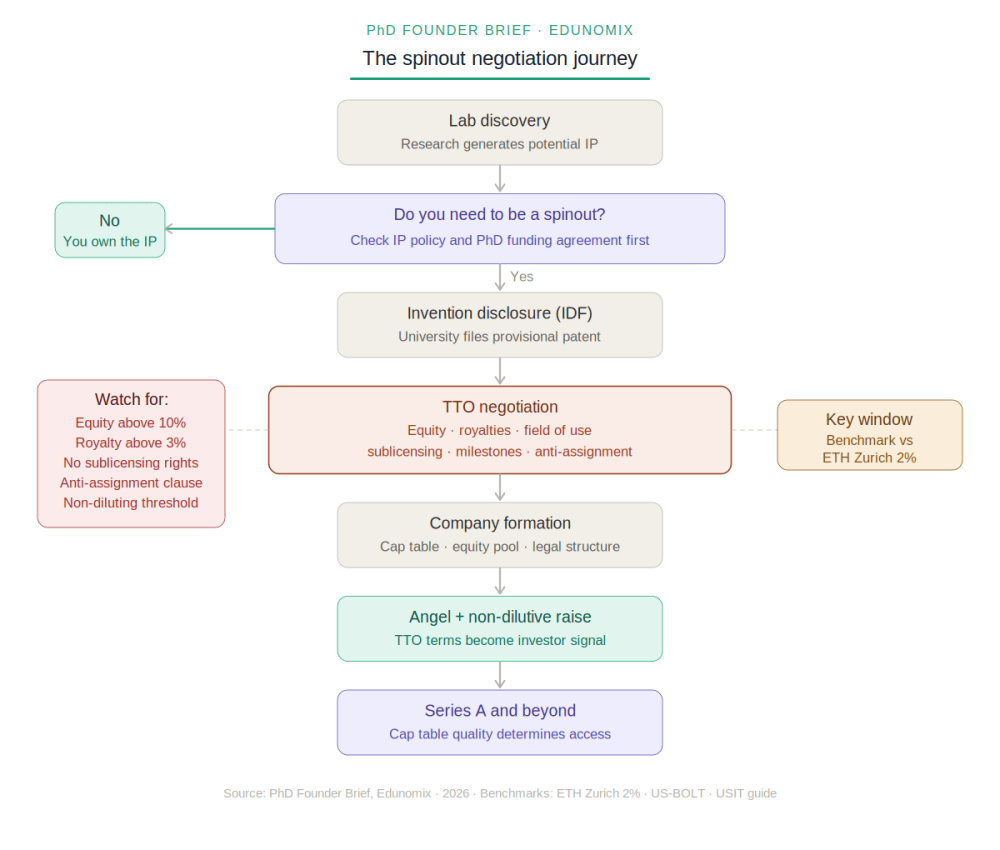
What terms should you get to know seriously?
First and foremost, equity.
If your university is asking for more than 10% equity in your spinout, you already have a problem. You might think it’s a good deal, but an investor sitting across from you in twelve months will see it on your cap table and walk away. Don’t give away what you don’t have to.
Equity terms differ widely by country, so your options may depend on where you are. The current norm for British TTOs has historically run up to 50% equity in tech spinouts, though significant reform is underway. By contrast, US universities typically take as little as 5–10%, a gap that reflects different institutional funding models and incentive structures rather than different intentions.
In the US, the most useful reference point is the US-BOLT (University Startup Basic Out-Licensing Template), a standard term sheet negotiated by universities, VC firms, and law firms, and publicly available for biotech and climate spinouts. It is the most advanced standardization effort globally and a powerful negotiating anchor. One thing to watch: some US universities ask for non-diluting shares even up to a Series A round which is less common than in the UK but worth checking in any US term sheet before you sign.
What matters for founders everywhere is knowing the global range before walking into a negotiation, and understanding that the best TTOs, including those that have adopted the USIT guide and express licensing models, are actively moving toward more founder-friendly terms. You should insist on them, and remind your TTO that they are out of line with global norms if they aren’t. Here are the benchmarks worth citing directly in front of your university officials:
- ETH Zurich (discussed in a previous post) charges 2% equity through its express licensing model, which is negotiation-free, completed in six to eight weeks. That is the best-in-class standard against which every other TTO should be measured.
- The University of Southampton has deliberately set equity at the lower end of recommended ranges, with founders retaining 90–95% equity. MIT and Stanford typically take around 5%.
- The US-BOLT (University Startup Basic Out-Licensing Template) standard, which is a term sheet negotiated by universities, law firms, and VC firms, provides a publicly available reference point for biotech and climate spinouts; and they are competitive. Know these numbers.
Country-by-country detail for Asia, the EU, and Switzerland is in the sources section below.
Second, critical non-equity terms
While founders often obsess about equity percentage, other terms can be equally consequential, but often less visible.
Specifically:
Field of use. A university license grants you the right to use the IP in a defined field. Too narrow a field limits future pivots and adjacent market opportunities. Here, you want to push for the broadest field of use that the university will accept, and think carefully about where your technology might go in five years.
Sub-licensing rights. If your commercialization strategy involves licensing your technology to third parties, you need sub-licensing rights in the agreement. Without them, you can’t execute a licensing revenue model. This is particularly relevant for dual-model ventures combining IP licensing with direct commercialization.
Reversion clauses. What happens to the IP if the company fails or misses development milestones? Reversion clauses can return IP to the university without a cure period, leaving you unable to restart or pivot the venture. Insist on a meaningful cure period and clear cure conditions before any reversion is triggered.
Anti-assignment provisions. Can you transfer the license in an acquisition without university approval? Anti-assignment clauses that require TTO sign-off on any M&A transaction can kill acquisition conversations. Acquirers do not want a university veto on their deal. You should negotiate this out early.
Non-diluting equity thresholds. Some universities set a condition where their equity does not dilute until the company has raised a minimum external amount, often €2M or $2M. Until that threshold is crossed, the university stays at its founding percentage while founders dilute with every new investor. This hidden mechanism extracts more value from founders than the headline equity number suggests.
The conflict of interest trap. Many universities have conflict of interest policies that prevent students or employees from negotiating with the TTO while still affiliated with the university. This is one of the least discussed and most consequential structural problems in the spinout process.
If you can’t negotiate directly, you still have options. You can find an unaffiliated co-founder to lead the negotiation; engage a lawyer with spinout experience; or bring in an advisor who can negotiate on your behalf. At some universities, such as Harvard, you can incorporate while still affiliated and then set yourself up as a consultant under certain terms that the university accepts.
Founders should identify this constraint before speaking with the TTO representatives, not during the meeting. The founder who arrives without knowing they cannot legally negotiate for themselves is truly in cloud-cuckoo land.
Recap: red flags in any spinout term sheet
As noted earlier, the best TTOs have already moved away from some of most onerous and restrictive terms; after all, their spin-outs are operating in a globally competitive market and they need to succeed. If your TTO is operating to USIT standards, the US-BOLT framework, or an express licensing model, you probably don’t have to worry. But there are still red flags out there, which need to be recognized, and pushed back on, in any negotiation.
To recap:
- University equity above 10%
- Royalty rate above 3% on net sales
- Non-diluting equity threshold that keeps university equity high through early rounds
- Field of use narrower than your current or plausible future technology application
- Anti-assignment clause requiring university approval for any acquisition
- Reversion clause triggered by missed milestones without a meaningful cure period
- No sub-licensing rights
- Diligence obligations with timelines misaligned to deep tech development cycles
ONE ACTION
Do three things before your next (or first) TTO meeting:
First, determine whether you actually need to be a spinout. Read your university’s IP policy and your PhD funding agreement this week. In some geographies and funding structures the IP is already yours. Don’t make assumptions.
Second, benchmark the equity ask. Whatever number the TTO puts on the table, compare it to ETH Zurich’s 2% express license, the US-BOLT standard, and the USIT guide. All three are publicly available. Know what best-in-class looks like globally.
Third, identify your negotiating proxy before the meeting. If your university’s conflict of interest policy prevents you from negotiating directly, find an unaffiliated co-founder, advisor, or lawyer. The 6-12 month fundraising clock that often starts after a spinout is formed will be impacted by the strength or weakness of the deal you sign today.
Negotiate carefully.
Regional reference notes
The following is a brief regional breakdown for founders outside the US.
United Kingdom: The current UK norm runs up to 50% equity though reform pressure is significant. The USIT guide established a reference point for investment and licensing practice in life sciences, followed by USIT for Software. A globally competitive standard proposed by leading UK investors would offer TTOs a choice of 1–5% common equity, 1% royalty on net sales, or 1% of exit value upon M&A or IPO. Use this as your benchmark. The UK government is being pushed to create TTO performance indicators tied to spinout formation rates, which means institutional incentives are beginning to shift.
EU and Switzerland: ETH Zurich’s 2% express licensing remains the global standard. The European Commission has committed to developing a framework for IP valuation for IP-backed financing, expected Q2 2027. Only one-third of European patents are currently commercially exploited, with insufficient researcher incentives cited as the primary barrier. The European Innovation Act, expected as a Regulation in 2026, aims to create a cross-sectoral legal framework removing barriers to commercializing research results.
Japan: UTokyo IPC runs a cross-academia accelerator called 1stRound, supporting approximately 16 startups per year with up to $70,000 in non-equity grants, plus legal and accounting services. As of December 2025, 27 Japanese universities and research institutes co-host this program, sponsored by 24 corporates. Japan’s model is notably corporate-linked; TTOs actively broker relationships between spinouts and corporate partners before equity negotiations begin, which partially reduces the equity extraction dynamic.
South Korea: KAIST’s spinout model is among the most active in Asia, with cumulative investment of 3.5 trillion won, a 92% five-year survival rate, and 24 public listings since 2021. Korean TTOs operate on more standardized government-backed terms than UK counterparts, with the national startup program structure providing a degree of founder protection that is less common in Europe.
Singapore and Australia: Singapore’s National GRIP and Enterprise Singapore programs support PhD-led commercialization primarily through non-equity grants, reducing the spinout equity burden before negotiation begins. National Taiwan University launched a $30M alumni-funded venture fund to invest in spinouts. The model of university-affiliated funds providing early capital is accelerating across Asia, offering an alternative to pure TTO equity extraction.
Sources
- Fifty Years: Spinout Playbook — A Guide to Spinning Out of Academia (fiftyyears.com/spinout)
- The Creator Fund: “Negotiating a Spin-Out as a PhD Founder” (February 2026)
- Strategic Spinouts: “The University Spin Out Playbook” (August 2025)
- The Stack: “Universities Holding Back Tech Spinouts with Equity Demands” (April 2025)
- Oxford University Innovation: “Starting a Spinout Company” (December 2025)
- University of Southampton Spinout Equity Guide (2024)
- Global Venturing: “University of Tokyo Fund Seeks to Back Corporate Spinouts” (December 2025)
- Cambridge University: “University Approaches to Spinout Equity”
- SETsquared Deal Readiness Toolkit Lexology: “University Spinouts — 10 Considerations for Founders”