
For decades, America has stood as the world’s premier destination for advanced education and research. This “brain gain” has fueled American scientific leadership, underpinned sustainable economic growth, and cemented our reputation as a hub for discovery and invention. Yet, in 2025, the U.S. advantage faces unprecedented threats—not only from global knowledge rivals like China, India and Europe, but from within, as recent Trump administration policies risk undermining the very foundations of America’s talent pipeline.
The U.S. “brain gain” is not a myth—it’s measurable.
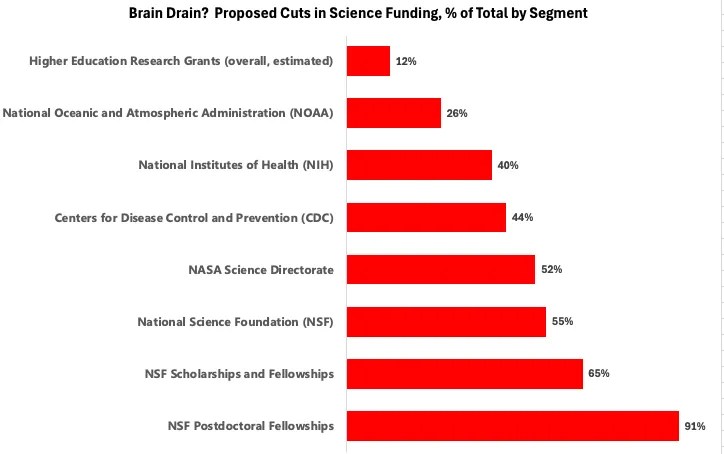
Source: Inside Higher Ed, Federal agency data (various), Gemini aggregated.
As an investor in career development platform Versatile PhD, I know first hand that over one third of our subscribers are foreign students on international visas, are leading lights in critical science and engineering fields, and make up an integral part of university and corporate-funded research infrastructure efforts.
Perhaps most importantly, most of them prefer to stay in the US after graduation or post-doctoral work. The U.S. has been remarkably successful at retaining foreign-born PhDs, which of course matters since federal taxes fund many of these programs. According to a study at Stanford, between 2005 and 2015 about 87% of China-born, non-citizen PhD graduates in science and engineering stayed in the U.S. after earning their degrees, contributing to research, teaching, and entrepreneurship.
The Trump administration’s actions will reverse this process:
- Cuts to Federal Research Funding: Reductions in NIH and NSF budgets have left universities scrambling for resources, jeopardizing research projects and graduate training.
- Visa Restrictions: Aggressive tightening of student and work visa rules, especially targeting students from China and other “strategic competitors,” has created uncertainty and anxiety. Reports of rescinded PhD offers and increased visa denials have had a chilling effect on international applications across the entire student pipeline, from high schools onward.
- Downgrading of Science: Rhetoric questioning the value of scientific research and interference in academic freedom have further eroded the sense of security for both domestic and international scholars. Even worse, the decimation of leading edge science jobs, including in the national science academies, is indefensible.
The impact is already visible: surveys of U.S. postgraduate students show that a majority are now considering leaving the country, international applications to U.S. PhD programs have dropped sharply, while other countries—Canada, Australia, Germany, and China—are ramping up efforts to recruit top researchers and students.
The stakes are high. If the U.S. loses its ability to attract and retain top PhD talent, the consequences could be profound for the economy and America’s leading edge in fields such as artificial intelligence, biotechnology, and quantum computing, all of which have national security implications.
Brain drain, once it picks up momentum, is difficult to reverse.
Photo by National Cancer Institute on Unsplash

 Edunomix